Tuesday, October 4, 2011

Post Card


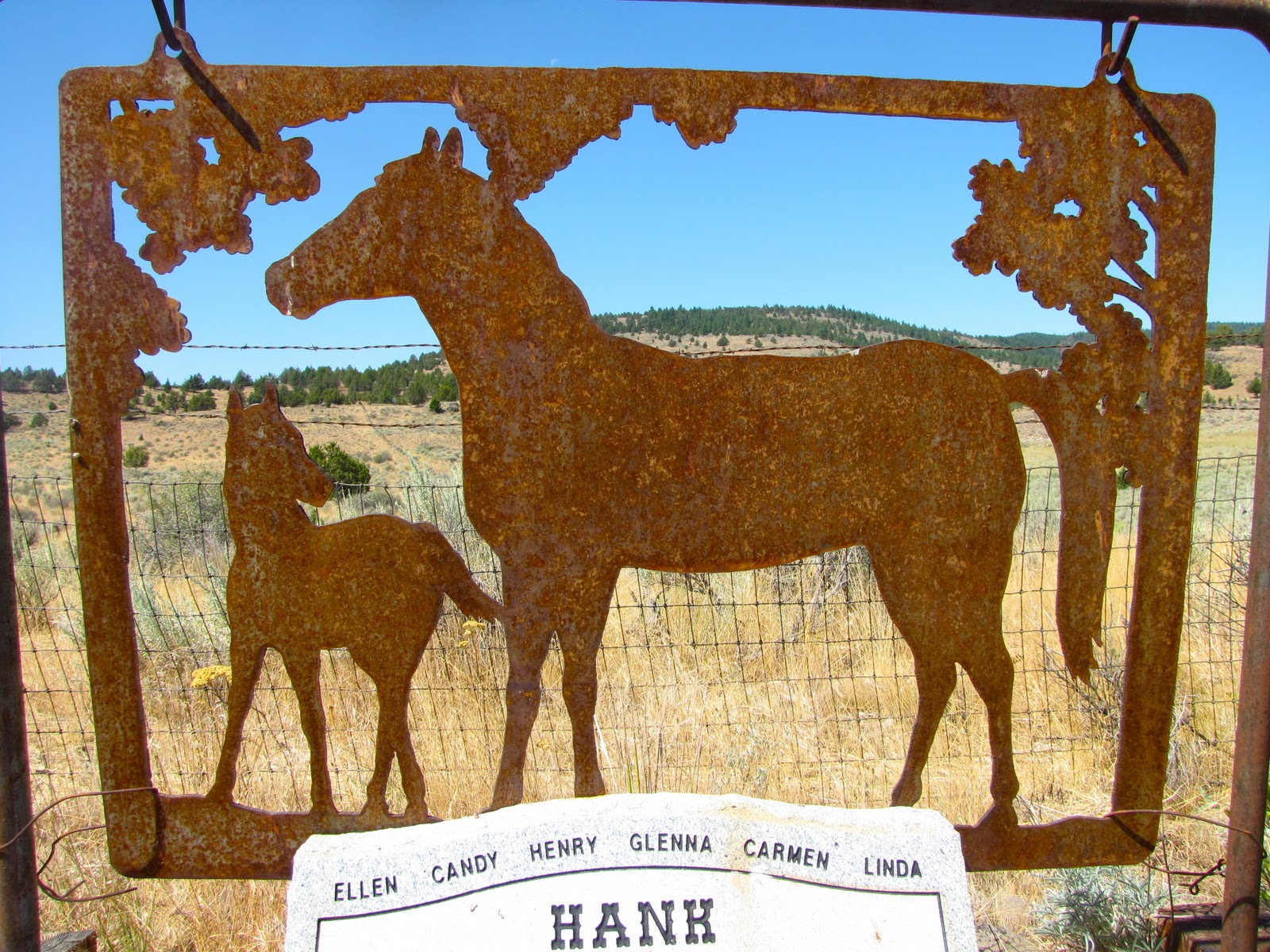
Pettys Cemetery, Ione, OR
First, the banjo.

Second, skip the bluegrass.

Rhythm banjo. I don’t like that barrage of notes that banjo players insist on throwing at the listener. I’m too old to get that fast. And they tend to loose the rhythm in that machine gun fire. It’s as if they don’t want you to hear the individual notes: “If I play incredibly fast, everyone will be so wowed that they won’t notice it’s a banjo.” When I first began to coax individual notes out of the banjo, I thought it sounded Japanese. Now I think of it as swamp rock banjo. Just what you’d expect there in the Northwest.

But I digress.

I’ll admit that I go through ten minutes of guilt everyday because I haven’t written anything lately for this blog. Then I get over it and go on with my day.

Denio Cemetery, Denio, NV
If I were to write a post, Id tell you that a bit back my son and I took a 1300 mile trip around the outback of Oregon. Aside from visiting twenty cemeteries or so, the highlight and ostensible reason for the trip was to drive the White Horse Ranch Road, a seventy five-mile gravel ride from just south of nowhere to its nearest neighbor. That would be Denio, a gas station surrounded by about thirty people who never make their presence known. Outside Denio, where other towns sport deer crossing signs, Denio provides donkey crossings. Wild donkeys, they have them there. They do. A hundred miles from Denio to Lakeview and we had it to ourselves except for the donkeys. Paved yet. The road, not the donkeys.

Unity Cemetery, Unity, OR
The countryside we traversed is the same country where Meek’s Cutoff is and where the movie of the same name was filmed. The original wagon train had something like 200 wagons in it. In the movie there are three. It stars Michelle Williams, who specializes in movies with enigmatic endings, often in Oregon. The Kings, Nahum (1783-1856) and his wife, Serepta, after whom Kings Valley Cemetery was named, were in that train. It is harsh country.

As I’ve noted elsewhere, one goes east to go to the West, if one lives on the wet (no, there should be no “s” in that word) side of the Cascades, which most of us do; but the West of Oregon is a far cry from the West of Colorado or Montana. That West got taken over by Hollywood, Las Vegas, and Texas. Less show and more grit up here. I don’t come here to get away from it all; I come here to come here. The photos are all up on Flickr.

Sunset Cemetery, Ontario, OR
I’ve been doing a survey of Lone Fir Cemetery Cemetery, our local crown jewell pioneer cemetery, for the past year. I wasn’t aiming to record every headstone, because genealogy is not my interest, but rather those in certain classes. The broadest and most subjective class are those stones of an “interesting” design. It’s hard to imagine a more subjective classification than “interesting.” It includes most all of the handmade markers plus those of highly unusual design, such as a spherical polished ball engraved with dragons or a scrabble board in full color.

Lone Fir Cemetery, Portland, OR
 The first person to have been buried at Lone Fir was Emmor Stephens, grandfather to a fellow named J. B. Stephens (after whom a Liberty ship was named). When J. B. and his wife died some years later, he had a monument which carries three-quarter life-size carvings of them both. That’s impressive enough, but on the reverse it has an equally notable epitaph.

“Here we lie by consent, after 57 years 2 months and 2 days sojourning through life awaiting    nature’s immutable laws to return us back to the elements of the universe, of which we were first composed.”

This is a mighty strong faith being expressed here, a faith in Mother Nature. It set a tone for the cemetery which rings to this day. Conventional religion creeps in here and there—it’s a cemetery, for Christ’s sake—but the overall ambiance is a full appreciation of this world and its universe. Carl Sagan could have written that epitaph. It’s why my wife and I chose to be buried here. And we were lucky; shortly after we purchased our plots, they closed sales on new ones.

But I digress again. Enough about me.

Another category is as subjective as design: interesting epitaphs. No “Gone but not forgottens,” okay? A third grouping is more defined: cameos, either photoceramics or portrait engravings; while the final sets have hard-and-fast edges: all Woodmen of the World and all white bronze markers. I did this survey with an eye towards A) giving tours of Lone Fir; and B) publishing a small guide to the cemetery. You’ll notice, none of my classifications have anything to do with who is buried there; that’s for the local historians and genealogists, whom I wish well.

But I couldn’t compile a guide to the cemetery without some knowledge of how it came together, so that’s taken me into a little research; which is all a round about way of explaining why I have ignored my guilt feelings and marched on with what I’m doing.

Then there’s the book effect. Having a book published is a little like getting a doctorate: instant credibility (unless you publish it yourself, then it’s an Internet diploma). Instant credibility is handy and a large part of the reason why the book came out as it did. When Ashland Creek sent an email inquiring if I was interest in putting a book together, I instantly knew that the important feature here was to get it published. And the sooner the better. Ashland Creek thought sooner was better for marketing purposes, and I thought sooner would be better for marketing myself. My presumption was the second book would be easier to publish than the first; hence I made almost no fuss with whatever Ashland Creek wanted to do. My mantra was, “If you guys like it, I like it.” 

That worked.

My focus, though, is on the future. The next time I’ll have a little more freedom to say, “No, the monkey in the gray flannel suit stays.”

Sunset Cemetery, Ontario, OR

Saturday, September 3, 2011

Mad As the Mist and Snow


Welcome to Mad As the Mist and Snow: Exploring Oregon Through Its Cemeteries. The title, a poem by W. B. Yeats, appears as an epitaph in Jones Pioneer Cemetery in Portland, OR, the first stanza of which goes:

   Bolt and bar the shutter,
   For the foul winds blow:
   Our minds are at their best this night,
   And I seem to know
   That everything outside us is
   Mad as the mist and snow.

Think of it as a tickler for the Oregon cemetery experience, designed to be taken to bed with you at night when you’re ensconced in a motel in Burns and are wondering what to do the next day. “Look, here’s something we could do tomorrow: visit the Fort Harney Cemetery.”

And Drewsey. Don’t forget Drewsey. Drewsey is a doozy.

The contents will be familiar to studious readers of Blogging a Dead Horse and followers of DeadManTalking as most everything is taken from blog posts or set introductions on Flickr. They’re easy to find, if tedious. On the other hand, a chunk of the book is given over to selected epitaphs arranged into categories; and while they all exist among the photos on Flickr, finding them is a major challenge. I drew them from a separate database of epitaphs not available on the Web, that’s easier to search than Flickr.

This is a case where the publisher contacted me; a rarity in the business, and for that I am eternally grateful. But it also means that I agreed to pretty much whatever the publisher wanted and the result is a heavily edited version of what you’ll find in the blog or Flickr. That being said, it’s a text-driven book, not a coffee-table book. That will come later and will cost a bunch more. At $22.50, this one is a steal. Okay, if not a steal, then a long-term borrowing.

What I’d really like is to drag you out to the cemeteries with me so we could both exclaim, “Wow, look at this!” Alas, you live in Massachusetts and I live in Oregon.

But if you can’t get out to see Oregon cemeteries, don’t worry, you have equally wonderful cemeteries in your backyard. Everyone does. If reading this book makes cemeteries pop out and seem fun to you, hop on your bike or slide into your car and head for the hills. Or the hollows or the flats. Or the northeast part of town, wherever dead people congregate. It’s free and its visceral. Parks with art and reading material. Pathos and tenderness. Stone-cold history and angels; what more could you want?

The book is available at Ashland Creek Press and should show up on Amazon is a week to ten days. Or what the heck, send me $22.50 and I’ll send you a copy, shipping free. Is this too good to pass up, or what?