Showing posts with label river view. Show all posts

Thursday, January 29, 2009

Greatness Large & Small

Eugene Masonic Cemetery

Some are born to greatness, others acquire it after long struggle, and others have it thrust upon them. People? No, cemeteries, of course.

I recently ran across a one-post blog (there are a lot of them out there) that said some tantalizing things about cemeteries and made a number of suggestions as to how to pump more life into them, which may seem a touch counterintuitive. My favorite suggestion was to stick a high class restaurant into the middle of them, although I’m not sure how that would work. You go talk to your local cemetery about it.

The author also suggested some things already being done in some cemeteries such as readings; small, historical drama presentations/reenactments; concerts; etc. All in all, practicality of some ideas aside, it was good to see someone thinking about how to restore cemeteries to their former glory. As anyone with a passing knowledge of cemetery history knows, cemeteries were the precursors to parks; and while parks have evolved to fulfill functions cemeteries couldn’t approach, it doesn’t mean that they have outlived their usefulness as parks.

Lone Fir Cemetery

There are two cemeteries in the Dead Man Talking database that are heading back towards being parks. Indeed, they already are parks as much as they are cemeteries: Portland’s Lone Fir and the Eugene Masonic Cemetery. The Eugene cemetery is an exemplar of the rural cemetery movement and had a streetcar line delivering people to its doorstep, even though it was, like other “rural” cemeteries, out in what was then the countryside. That was being born to greatness. Unlike Portland’s River View, a rural cemetery which also was built for but has continually maintained its greatness, Eugene Masonic had a long period of decline and suffered serious vandal damage (and still does) before being consciously returned to greatness by taking a radical new approach as to how the cemetery is regarded and used. It’s all Eugene and all Oregon and it gets constant use by its neighbors. Lone Fir also gets constant use, though it approaches being a park in a more traditional manner.

River View Cemetery

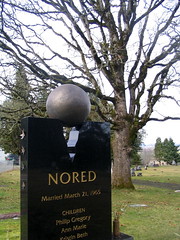
Eugene Masonic is notable at first glance for its shaggy appearance and at closer inspection for the minute detail with which the cemetery is cared for and presented. It looks shaggy because the site is mowed but twice a year and functions as a local wildlife habitat for both animal and plant species. Walking paths throughout the cemetery are kept mowed and are sprinkled with signs ecumenically pointing out significant local species or interesting interments; and to their credit, the interments signaled out for illumination are not necessarily those of city luminaries, but also include short bios of more representative citizenry. (Historical markers always tell as much about the erectors of the markers as the people or events they are commemorating.) They’ve also begun to allow green burials, have erected a charming viewing platform and scatter garden, restored an art deco mausoleum on the property, and a local Jewish organization has reserved part of the cemetery for their members’ use (a practice also found in two Portland pioneer cemeteries). Things are hopping there and neighbors love to come there with their children and dogs, which are kept on the paths and scrupulously cleaned up after (both kids and dogs).

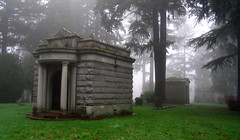
Lone Fir, on the other hand, began life as a Donation Land Claim (DLC) cemetery; which simply means that the original owner of the land set aside part of his or her holdings to serve as a cemetery, one of the most common origins of Oregon Territory cemeteries. Lone Fir grew to greatness due to its location. It too was built in the countryside and soon swallowed by the city outside which it lay. It grew to greatness by having a rich and complex history, which is still evolving. Not designed as a “rural cemetery,” it nonetheless is a major city arboretum and that lone fir (which still stands) has been joined by an astounding variety of trees. It also contains some nice little niche areas, such as a firemen’s section, a heritage rose garden, a Gothic mausoleum, and an emerging Chinese memorial commemorating the Chinese who were disinterred from this cemetery and shipped back to China, providing, of course, that they were adult males. Chinese women and children were left behind. Lone Fir is also the repository for the lion’s share of the interesting monuments in the city; and this goes back to the early days, as it harbors by far the city’s largest collection of Woodmen of the World faux stumps. Yet the modern revival of individualized memorials is well represented here too, with striking new monuments. Not to mentions the proliferation of Russian tombstones with their fanciful scenes and babushkaed photos laser-etched onto black granite. They are ubiquitous. Along with their gardens. The Russians love to create miniature gardens on their cemetery plots, and all summer long you’ll see well dressed women hiking back and forth between water spigots and small garden plots. As a consequence, the once somber tones of the cemetery have been enlivened by countless color spots. It’s all good.

And as a consequence Lone Fir gets heavy use. Not only are the plots going fast (we bought two), but the place is always attended by people. All manner of folk drift though reading the stones or stopping by for a picnic lunch, weather permitting. Musicians can sometimes be found playing quietly in the marble forest, and many a reader has found a comfortable stone to rest their back upon. Drinking isn’t a problem; the grounds are much more likely to be used for smoking a joint. It’s still peaceful, after all.

But greatness in a cemetery is not necessarily defined by its use as a park. Most of the cemeteries in the database that I’d mark as “great” (and surely greatness, like beauty, is in the eye of the beholder), get little or no park use. Which may be too bad, but it’s true.

Mountain View Corbett Cemetery

“Great” has more to do with ambiance than size. Location helps. Mountain View Corbett Cemetery, the eastern most of Metro’s fourteen pioneer cemeteries, has such a close-up view of Mt. Hood and the surrounding agricultural fairyland that, if the wind’s not blowing, makes it a delightful place to be. For a tiny cemetery, it has more than its fair share of personalized monuments, another mark of a great cemetery. Taft Pioneer Cemetery with its majestic view of the Pacific Coast has also inspired above average memorializations. Pleasant Hill Cemetery, on the other hand, while having one of the best caches of personalizations in the state, is located smack alongside busy Hwy. 58 southeast of Eugene. I attribute its lively character to being close to Ken Kesey’s ancestral home. There’s still many a Merry Prankster hiding in the woods of Lane County. In any event, it proves one can have a splendid cemetery in a mediocre setting.

Pleasant Hill Cemetery

Genealogists and local historians might qualify “great” by who, how many, and what kind of records a cemetery possesses. Willamette National would qualify by many standards as a great cemetery, but other than nice lawns and beautiful committal chambers its really only “great” aspect is the personalized memorials hidden behind berms at committal shelter no. 3. Those moved me to tears. But I can see a genealogist going ga-ga over the records. Though I can’t understand how the Vietnam Wall can get such publicity, while the memorials behind the berm are ignored. Go to Dead Man Talking Flickr site and see for yourself. It only scratches the surface.

Willamette National

I qualify cemeteries by how I feel when I stroll around them. That’s how I began. Inveterate backroaders, cemeteries have long been a pleasurable stopping point for Kay and me while traversing the outback. A good place to check out a few stories, get a grip on community history, and see how the locals handle death. Always a fun trip. Approached that way, a cemetery has to stand on its own merits. The stories behind the tombstones will remain enigmas. The making up of ones own imaginary history is often good enough. In any event, who is buried in a cemetery is of little import for the casual visitor, and what constitutes “good” in a cemetery has to be apparent at first glance. Cemeteries are defined by the memorials they keep.

Taft Pioneer Cemetery

That’s my take, anyway. Thank God you have yours.

See you at the sepulcher.

Thursday, April 24, 2008

Sacred Ground and Digital Archaeology

north palestine cemetery - palestine, or
North Palestine Cemetery


I work with sacred ground: cemeteries. There are other types of sacred ground — churches and the like, battlefields, virgin springs — but cemeteries are pretty much universally accepted as sacred ground. At least if they’re your cemetery. If they’re somebody else’s cemetery, they’re fair game for looting. The world’s museums are stuffed with artifacts stolen from cemeteries, up to and including the bodies themselves. But if it’s your grandma and grandpa, hands off. If the looting is done publicly and at a decent time remove, it’s called archaeology.

But the bottom line is a cemetery is a cemetery is a cemetery. Make that your mantra.

A cemetery is composed of dead bodies and their associated artifacts. Among other things, the artifacts tell you the cemetery is there. Without them the bodies belong to the nameless stream of dead people long since disappeared. The most important artifact in a cemetery is the one that tells you that it is there. If it’s lasted for any length of time, it’s probably stone. It’s called a tombstone. The rich can build their whole tomb out of stone; then it’s called a mausoleum. A mausoleum is a glorified tombstone. Among the more notable mausolea in the world are the Taj Mahal and the Egyptian pyramids.

river view cemetery - portland, or
River View Cemetery (Portland)


All cemeteries are liable to be robbed. For some reason human skulls have a value all of their own, not to mention burial offerings. Public theft — that done by archaeologists — has the virtue of A) keeping the artifacts in the public eye, and B) if we’re lucky, advancing our knowledge. Archaeology is first and foremost the study of three things: fire pits, garbage heaps, and cemeteries. Post holes are good, too.

When an archaeologist studies a grave, he or she, aside from looking at the body itself, inventories the associated artifacts, which we commonly call the “grave offerings,” although they all don’t serve the same purpose as the word “offerings” implies; some artifacts are more decoration rather than offerings to the dead or to the spirits of the dead; perhaps “ephemera” might be a better term to cover both. Traditionally, of course, the artifacts are simply taken back home with the archaeologist to their university or other supervising institution, the better to preserve and study them, being the rationale.

agency mission cemetery - mission, or
Agency Mission Cemetery


Just exactly what the purpose and understanding of ephemera are, though, is a matter of interpretation, and undoubtedly many different forces come into play; but when food offerings are found at a grave site, for instance, it’s not clear that the people who left them actually intended them to be used by the deceased rather than leaving them as a symbolic gesture. One has to presume that the concept of symbolism dates to very early human existence. For the observer, it’s not important that the ephemera are not meant for the deceased’s actual use; they’re significant because they indicate what the survivors — and presumably other people of their time and place — thought important. Grave ephemera, then reflect the people and times in which they are offered. That’s what the stuff found with King Tut does: it helps explain Egyptian life in those times. That’s what archaeologists do: they try to make sense of peoples and times through what they throw away and what they leave for their dead. It’s a very time-consuming task.

apostolic cemetery - silverton, or
Apostolic Cemetery


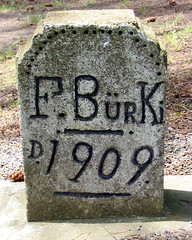
The first “offering,” as it were, is the marker itself, the object that tells you a grave is there. The marker is important because without it people wouldn’t know where to come to remember the deceased; and ultimately cemeteries are not about stashing the dead somewhere, but about not letting people die. Cemeteries are where the connections between the quick and the dead are maintained. No one in a cemetery, if they have a marker, is truly dead. The marker can be considered “the permanent offering.” It’s the offering that’s not ephemeral. Its importance is that it locates the place of remembrance and the place to which temporary offerings are brought. Without the permanent marker everything quickly fades. Cemeteries, if they don’t obviate the process, at least slow it down.

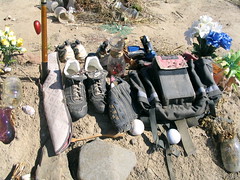
American grave ephemera include anything left at a grave site excepting the monument, from a simple flower or a pebble to complex assemblages of hundreds of items. Through a combination of decay, cleanup, and theft, grave site ephemera disappears relatively quickly and from times past we have no record of what was left at our graves. We can find grave ephemera from other eras and places where ephemera were buried with the deceased, but for the most part that has never been an American custom; and consequently, most everything ever left at graves here has long since vanished.

Interestingly enough, though, while grave ephemera from other cultures — Peru or Egypt, say — excite great interest and study, to my knowledge local ephemera has always been ignored. Which only means, of course, that vast amounts of information have been lost and that the opportunities are endless. (The worry being, inevitably, that the opportunities will continue being ignored.) With the advent of digital photography it’s become economically feasible to amass large collections of ephemera pictures dripping with anticipation that someone will come and sort them. My only regret is that we don’t know what people left behind at graves in the 1940s, much less the eighteenth century. We only know what the Egyptians left behind.

brown cemetery - beatty, or
Brown Cemetery (Beatty, OR)


Grave offerings open tremendous windows into the deceased, their culture, and their times. They tell us more about those who left them than about those for whom they were left. The amount of cultural information packed into one picture of grave site ephemera is quantum leaps above the information conveyed by tombstones alone. Unfortunately though, it’s apparently a case of always being unable to see the forest for the trees. Current ephemera is too much under our nose to pay attention to it, and once it’s gone we never knew it was there in the first place.

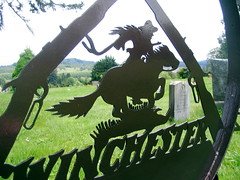
Winchester Rifle - Alpine Cemetery
Alpine Cemetery


In tombstones the corollary to ephemera is “personalization,” which is the monument industry’s jargon for anything carved into a stone other than names and dates. There has always been some degree of personalization of tombstones, a practice which has waxed and waned in popularity depending on custom, technology, and materials. And there have always been “handmade” markers as well as professional ones. There has been some limited academic attention paid to professional representations in recent tombstone personalization, which has been largely anecdotal rather than analytical and dealt with small databases.

Which is all a round about way of explaining what I do, what the DeadManTalking collection is about. It took me several years to figure it out myself, so don’t worry if it’s not clear to you, it’s still foggy to me. I also know that, whatever I think my mission is today, I will think differently in a year.

I collect grave site offerings, permanent and ephemeral. I am a digital archaeologist. I record objects brought to sacred ground to bask in and add to the spiritual powers present there. I don’t loot any graves. I don’t take anything away to display or to sell. What I do is record a world that will be gone tomorrow. Like the river that is never the same whenever you step into it twice, the cemetery you visit will not be the same one I saw. I’m showing you the soft inside of the culture of the Oregon Territory as it stands at the beginning of the twenty-first century. It will never be seen again. Enjoy it while you can.

canyon city cemetery - canyon city, or
Canyon City Cemetery