

There is, arguably, no American image (Uncle Sam notwithstanding) more iconic than that of the cowboy. Along with the equality myth, the myth of the West has done as much to shape our self-image as any other vision. Clint Eastwood and John Wayne, for good or ill, have shaped the world’s image of American as much or more than anybody. And jeans, don’t forget, say “cowboy” anywhere in the world, and are proud of it. You can’t unconsciously wear a Stetson in Maine, much less in Kuala Lumpur, without drawing snickers (as in, “all hat and no horse”); but you can wear Levis in Lithuania without drawing a glance. Everybody can wear a pair of jeans and feel a tad more “with it,” not to mention comfortable.


I’ve previously put together a gallery of tombstones with a Western motif. This time I’ve focused on the singular image of the cowboy. I suspect one might find a cowboy image engraved on a tombstone anywhere in the United States, but the legitimacy of the image doesn’t manifest itself until the Great Plains and the West. Out here the cowboy still exists and still looks pretty much like he (usually a he) always did, excepting that you’re as apt to find him on an ATV or a pickup as on a horse. Without flogging a dead horse (gee, that phrase sounds familiar) too much, it has to be pointed out that these monuments are all recent. We’ve had cowboys here for 150 years, but you’d never know it by gravestone markers; as far as they’re concerned, cowboys just arrived.


With only a cursory glance, you’ll notice a number of trends and/or common themes/motifs. Most noticeable is the large number of handmade monuments. Several of Oregon’s most distinctive grave markers have a cowboy theme. If one is going to go to all the trouble of cutting out a marker from sheet-metal, it is reasoned, it might as well say something.


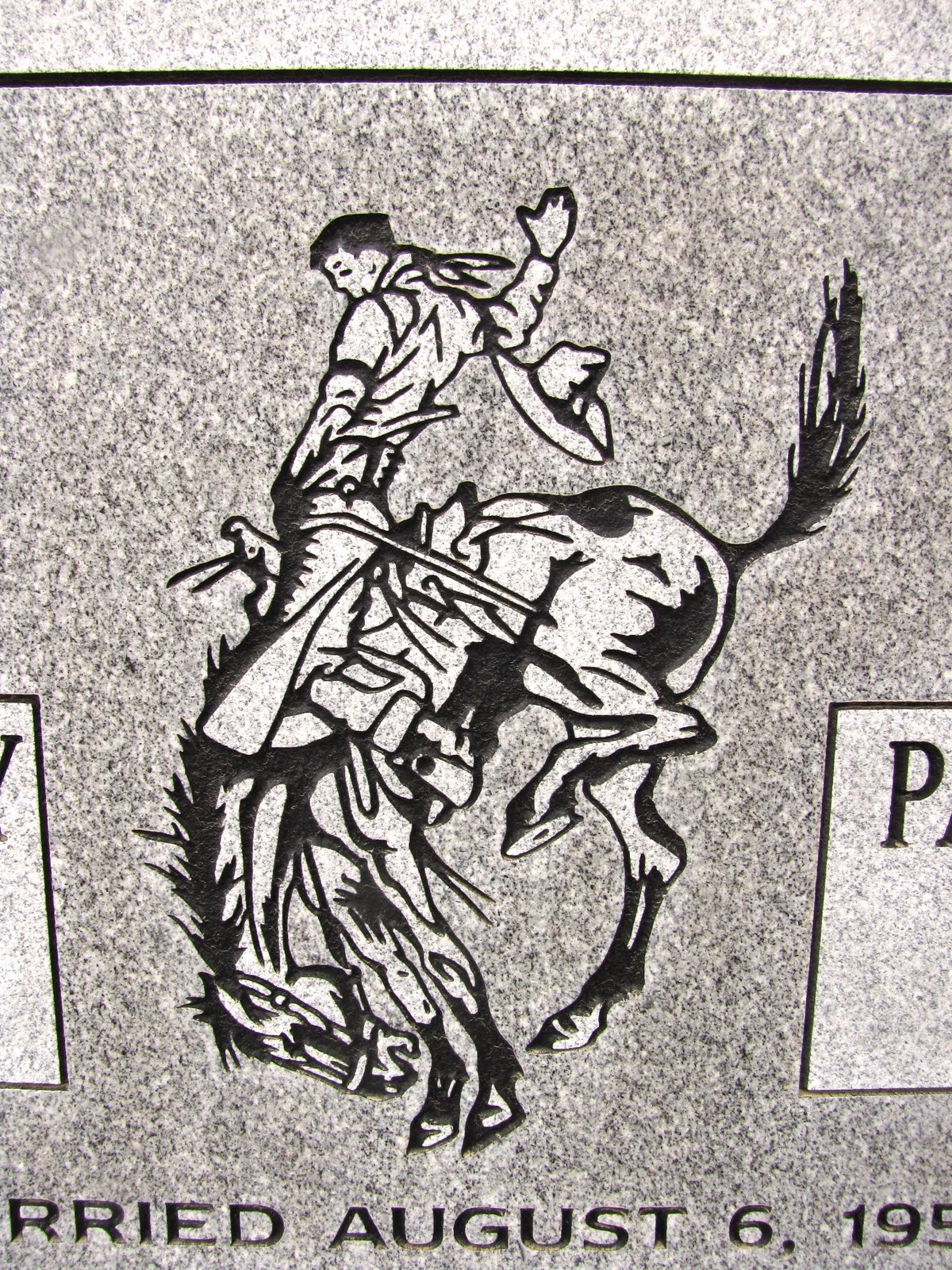
Inevitably, any tombstone image conveys more information than simply the person’s visage, if only information about hair styles and a cultural reluctance to display more; but cowboy images offer the viewer an entire world of extraneous data.


For ease of identification, fortunately, the cowboy is universally recognized by his hat and his horse. There is an entire accompaniment of clothing, gear, and tack which go along with the hat and horse image, but those are the two elements that are iconic and are almost always present.


The image of the cowboy is often paired with an image of his work-place, the vast Western landscape. To the extent that all people are molded by their surroundings, the dramatic landforms of the West are constantly part of its peoples’ self images. It’s why for so many of us we had no choice but to follow the allure and climb aboard the Oregon Trail. The reproduction of the landscape on tombstones is faithful enough to local conditions that one can often get a good idea of location from the simple sketches available.

Working details of a cowboy’s life are often found among the etchings, including the kind of stock being tended. I have one etching of a horse leading a pack train, and several of bucking broncs. One image I throw in with the cowboy images is of a homemade cutout of a galloping rider beneath crossed Winchesters. We know they’re Winchesters, because that’s what’s written beneath the rider. (That rider, I’ll confess, is most likely a Pony Express rider, but the image is indistinguishable from that of the cowboy.) Dogs are often depicted, as well, showing not only their companionship but are included among the working images. I’m not aware of dogs being a part of the Plains/Texas tradition, but they’re integral to stock management in the Oregon Territory.


.jpg)
The cowboy is often accompanied by a cowgirl, most assuredly his wife. I also have in my collection a photo-ceramic of one saucy/defiant cowgirl, sans cowboy but avec hat. A lot of women do work cattle these days, but they tend to dress with less panache than the men or than the images imply; more like contemporary Indian women, synthetic quilted jackets from REI. Everyone looking a little like the Michelin Man.
.jpg)

You’ll note one photo-ceramic of an Indian cowboy. I’ve probably gotten into as much trouble in Oregon over what to call cowboys as I have over anything else. The first was around a communal dinner table in French Glen where it was explained to me by a ranch hand that they were “buckaroos in these here parts,” thank you, not cowboys. Later I had an equally impassioned Native-American explain to me that her people were Indian cowboys, by God, not common buckaroos. Ignorance, they will tell you, is no excuse.


Religion isn’t strongly represented in combination with cowboys, although it does crop up sporadically; one of my favorites being of a cowboy riding herd on a mixed bunch of cows and calves, and carries the epitaph, “The Lord is my shepherd.” There’s a certain irony in a cowboy surrendering himself to a sheep-herder. I’m not sure I’d want to put that on my tombstone.
Some of the most poignant and touching markers are ones with no human image at all. How can you not love the Cowboy Pastor, knowing that he’s “Loved By God & Family”? Or how can you not be moved by the single spur imbedded in cement or the ubiquitous coil of rope. Many an old cowboy boot has found its final resting place in a graveyard, as well.

For poignancy, though, it’s hard to top the simple concrete marker in quintessential Camp Polk Cemetery, one with plastic lettering pressed into cement and an outlined sketch of a hat. No name, just the declaration: “Cowboy/ 19 yrs/Horse Kicked.”
It happened just like that. Snap!
.jpg)


