Showing posts with label oregon. Show all posts

Wednesday, July 28, 2010

Visions of Lone Fir


Kay and I were among the last people to secure plots in Lone Fir Cemetery. If we’ve discombobulated our lives, at least we got death right.

Thanks to an intersection of forces and interests, Lone Fir is returning to what cemeteries were supposed to be about in the first place: edification and entertainment. When cemeteries were first proposed in the early 19th century, the idea was that glorious monuments in a park-like setting would induce people to high-minded civic behavior. And for a time, cemeteries did just that: they enticed people out of the cities to stroll through the trees and monuments to, if not always civic leaders, at least rich people. They were known as “garden cemeteries” or “rural cemeteries,” on account of their being plotted far into the countryside (long since engulfed by urban growth everywhere). They were so popular that towns like Portland and Eugene built streetcar lines specifically for them. They were so popular, in fact, that towns eventually began building cemeteries without any bodies in them, at all. They called them “parks.”

What an idea! And as the park movement spread, people forgot that they were supposed to go out to the cemetery for a good time. Indeed, in early New England, cemeteries were often the only place in town big enough to hold all the living people, forget about the dead ones. Cemeteries tried to recoup by making their new cemeteries look like the new parks: big expanses of flat lawn, only they didn’t encourage picnicking or frisbee. They succeeded in making them look like parks, but they killed off the reason for visiting them: what’s to see?


In the meantime, many traditional, now urban cemeteries languished from neglect and vandalism. Lone Fir was lucky: it didn’t languish. It held on as neighborhoods grew around it and the city pushed miles beyond. The lone fir was joined by a veritable arboretum, which now sports its own guide. It was lucky in that it held enough quirks and oddities, beginning with the almost life-size relief carvings of the founding couple, to keep up a continual flow of traffic. True, the war memorial lost its statue, half the heritage roses in the rose garden had disappeared, the mausoleums were crumbling, but still it hung on in the hearts of Portlanders. Maybe it languished a little.

It was the hearts of Portland, though, that spurred the revival. Lone Fir is back and it’s better than ever, thanks to the citizens of this town who have an inordinate love of the burg going beyond all reason. They admit that there are other nice cities in the world, ones dripping with sophistication—Paris, say—but, ah, they sigh, they aren’t Portland. Which, no matter how you look at it, is true. I can guarantee you, Paris is not Portland. Nor the other way around. But the first force to resurrect Lone Fir was the general citizenry of the community. Portlanders simply like the place and are willing to put their wallets where their hearts are.


One way that manifested itself was by the formation of an advocacy group, the Friends of Lone Fir, which has taken a vigorous lead in preserving and promoting the civic space. They are the people who have put on the shows, lead the tours, and personally gotten out there and spruced up the place. Without their active and watchful eye, perhaps none of this might have been accomplished. What’s truly amazing is that they aren’t a group of octogenarians keeping watch over their future home; they’re young people (okay, okay, there are some elder statespeople there) who have already caught the Lone Fir fever. There are seriously delirious people in that group. Portland is blessed by being a magnet, not only for young people, but a magnet for a particular class of young people: the I-can-do-that creative kind. Not only have they crept into the Friends of Lone Fir, but they’ve tapped community creativity to, among other things, produce a CD of songs written specifically for the cemetery by a bevy of local musicians (not to mention a comic book). And we have seriously delirious local musicians here, as well, as you might imagine. Lone Fir was lucky in being born in what was to become at the turn of the 21st century the locus of Portland’s youth infestation, the Eastside.


A Lone Fir quirk that particularly delights Eastside denizens and which has provided a impetus for the cemetery’s reemergence is the popularity of an historical vignette, concerning one Dr. Hawthorne, who is buried there, along with many of his patients. It’s helpful to know that Hawthorne Ave., not too far from Lone Fir, was the epicenter for the gentrification of the entire Eastside and which has now engulfed the entire city. This was where the hip, young kids moved to after the Alphabet Blocks got priced out from underneath them. Hawthorne was, and still emotionally is, their street.

But that’s just the half of it. The other half is that Hawthorne Ave. used to be named Asylum Ave. after an insane asylum at its eastern terminus. The good doctor was the head of that asylum and his patients were buried in unmarked graves along with him. It’s just the sort of story that young goths would like. How could they not love Lone Fir?


Not all the unknowns were asylum inmates, though. They were joined by transfers from earlier, more centrally located cemeteries and by scores of Chinese. The local Chinese community has provided the second big push to renovate the cemetery, even though most of the Chinese remains have long since been returned to China, at their behest. What China didn’t behest were the bones of the women and children; they weren’t important and could be left bereft in foreign soil. It is the modern, local Chinese community (in the form of the Chinese Benevolent Association), whose sensibilities have grown with the times, that has pushed for greater recognition of the Chinese contribution to our culture and to Lone Fir, and wants to honor those women and children who are still here. And is, perhaps, a touch sad that the men aren’t here still, too.

For a long time the denizens of Block 14, where the Chinese and asylum patients are buried, was under the footprint of a three-story office building housing the agency, Metro, which oversees the local pioneer cemeteries, as well as a host of other responsibilities of, arguably, greater importance. Fortunately, the spawning of Friends of Lone Fir and the awakening interest of the local Chinese community coincided with a need for Metro to find more space and vacate the building. Once they were out and the building gone, planning could begin in earnest for a memorial at Block 14 for those once-forgotten communities. We’re in the middle of that process right now.


Part of the process was to have Block 14 blessed by the priests of a local Buddhist temple, which occurred on a recent July Sunday, along with the dedication of three “heritage trees,” and the showing of two documentary films, one of them about the Chinese workers and their families. That plus a little music. Wouldn’t be Portland without a little music.

It was a beautiful late afternoon. The temperature was kissing 90, but it was cool under the tall timber (the lone fir still stand, if no longer alone). I’d guess there were better than two-hundred people there at its busiest and it was comforting to see them wandering among the gravestones and laying their blankets out on a gentle slope down to a temporary stage in the Firemen’s section. It felt like home.

I had to get up early the next day, so I skipped out before the twilight showing of the films. As I was leaving, people were still trickling into the cemetery. Coming to the last crossroad before the exit, I happened to glance at a stone in one corner. It was from 1918, so I’d walked past it uncounted times. Delicately carved in a rustic tradition of rough-hewed stone, peeling signage, and ivy leaves, it’s small and unobtrusive. Not a stone that commands attention. One would hardly notice that it carries an epitaph, which isn’t carved into the face of the stone, as is common, but into the face of the pedestal upon which the small stone stands. Furthermore, the epitaph is hard to read without paying close attention and probably just says, “Too well loved to be forgotten,” anyway. The sort of stone you can pass by forever without really seeing it.

Nonetheless, once I noticed there was an epitaph, I was compelled to decipher it. Mind you, I’m having cataract surgery next month and everything is somewhat of a blur right now, so simple things like reading weathered epitaphs have become a bit of a chore. I had to crouch down and get close, which in itself is a chore, for a good look. The deceased was young Jess Nudsen (which Kay points out was probably “Knudsen”) who died in 1918 at the age of nineteen. I’ll probably never know how Jess died, which is just as well, knowing might remove some of the mystery; and part of the deep attraction of cemeteries is the wide sense of wonder one is so often left with upon viewing a particularly poignant marker. As it is, I was left with one of the most haunting epitaphs in my entire collection:

Some where, some time,
We’ll understand.

Saturday, July 4, 2009

The Siskiyous

Pilot Butte Cemetery

I am stalked by death. Many a morning I wake with a tight cold sweat and a taste of steel in my mouth. I feel the suspension of time that says a crisis is at hand. I am fine. Around me is death. Around me is a cancer eating at my friends and family. Around me people are waiting for the birth of a new child. Around me walk proud young women with newly extended bellies. A friend’s wife is told, “You have to decide on a place for him. A bed. A couch. Soon you will be unable to move him.” The doctor says months. The wife says no, sooner. He has seen the people he will see. I am on the long list. I have seen him for the last time.

Jacksonville Cemetery

Where do you go when you’re no longer here? Is there morning there?

Is there there there?

Chief Schonchin Cemetery

The Siskiyous

The Siskiyous are a jumbled mess of mountains straddling the Oregon-California border. They are what happens to the Cascades as they dribble out in their southern reaches. What distinguishes them from the Cascades is hard to say other than that they spread out into rugged terrain that for a time held one of the fiercest pockets of Indian resistance to the white invasion: the Modoc Indian War. Out here “Indian Fighter” on a tombstone is a not fanciful sobriquet, and the Modocs took down their share of soldiers. Gold strikes were common in these parts and camp town sprang up and disappeared overnight (cf. the introduction to Golden Cemetery on DeadManTalking, when it shows up). Life was as rough and tumble as the mountains.

Jacksonville Cemetery

Today the region is dotted with agricultural valleys separated by precipitous hills. Outside of the valleys it is sparsely populated, but the valleys hold concentrations of people that allow for quasi-independent development, and each city is the Mecca for its own micro-world. In the early days of white settlement Jacksonville was the center of travel and commerce and its cemetery reflects that former glory; it is one of Oregon’s great pioneer cemeteries and worth a trip to the restored town for it alone. Since those days, Medford, Grants Pass, Ashland, and Klamath Falls have run the show. Famous for fruit trees (Harry & David are from Medford), the region has long been a magnet for migrant workers who provide a vibrant addition to the cultural landscape. (Thanks to them, I can attest that you can find an excellent taco in Merrill among the braceros and the teenage girls in their skin-tight Levis.)

In 1941 the Army built a training camp, White City, north of Medford, which left its stamp on the character of the region, even though it was abandoned by the Army after the war. Nonetheless, the region prides itself on its conservative bent and the road signs for Klamath County (I believe) read “We support veterans.” (Let it be known that other parts of Oregon do support veterans, as well.) One legacy of White City is the nearby Eagle Point National Cemetery, which began in 1952 and has bucolic views over the neighboring farm land stretching off to deep-clad mountains.

Antioch Cemetery

Another nearby cemetery, Pankey Cemetery, had a curious involvement with White City. It was located in the middle of the gunnery practice range, not an ideal situation for tombstones; but the Army, bless its heart, sympathetic to the descendants of people buried in Pankey, prior to bombing the bejeezus out of the place, laid all the tombstones flat and covered them with six feet of sand. When they were done, they sucked up all the sand and tilted the stones upright again; although a volunteer caretaker confessed to me that she had a slight concern in the back of her mind that one day she’ll run across a live round left over from those times and meet her demise in that very spot. A short trip, she figured, provided they find the pieces.

Chief Schonchin Cemetery

Thanks to Southern Oregon University in Ashland along with a regional Shakespeare company, the region has also long been a draw for a more lettered and artistic class, which was joined in the 1960s and 70s by a wave of hippie immigrants who brought their own indelible style with them. More recently wine makers and organic, sustainable farmers and ranchers have begun to transform the region’s agriculture and, frankly, cultural life, as well. It’s a heady mix in an area where at least one town (Grants Pass) boasts a banner across its main street proclaiming: “It’s the climate.”

Woodville Cemetery

Scenery’s not bad, either.

Tag Ends

Chief Schonchin Cemetery

Nearly half the photos I brought back, though, are not from the Siskiyous but are distributed between central and south-central Oregon. I’d located four Native-American cemeteries before I departed, none in the Siskiyous. I found the four, but two were adorned with “no trespassing” signs, so there you have it.

I had hoped in this swing through Oregon’s high, dry farm and orchard lands that I would find quintessential Mexican grave sites, but alas, I was disappointed. Still, the best collection of Mexican graves in the state are in the Hilltop Cemetery outside Independence, in the heart of the Willamette Valley. Yet the proliferation of taquerias and taco wagons almost made up for the lack of colorful headstones. Aside from the outstanding tacos from the Merrill taqueria, I had serviceable ones from stands at the Deschutes River Crossing in Warm Springs and at the intersection in Wolf Creek, of all places. I never did find the Wolf Creek Cemetery, but a stop at the fire station directed me to the unmarked cemetery at Golden.

Pilot Butte Cemetery

All in all a successful trip, rich with photos. And aside from getting snowed off Hart Mountain on the Solstice (where the mosquitoes were pestiferous), the weather cooperated just fine.

Milo Gard Cemetery

Thursday, April 16, 2009

One a Year
Long-Liners: Fishing by Hand

Ilwaco (WA) Cemetery

Old Man Petersen slouched in the booth and stared across the blacktop at the plant bearing his name: Petersen’s Seafood. He didn’t take his cap off, but there wasn’t much to cover, anyway. His face was dark and furrowed from years of standing up to hard weather. His hands curled around a cup of coffee.

“Lost one a year for every year of my life, on average,” he said. That would be more than seventy fishermen; almost all men. He laid it out as a fact, like last year’s catch. “Every year someone doesn’t come back.”

Toledo Cemetery (Toledo, OR)

“More coffee?”

Now a-days we get updates from Shortman on who’s died in the past year, but now it’s from cirrhosis or cancer or heart attack or suicide, not from a slide into Davy Jones’ locker. A couple years ago when Roger Fisherman (as distinguished from Roger Treeplanter) took himself out of the race they blew his remains off into the South Slough with a canon. Third person they’ve done that way. Around here Hunter Thompson would just be one more guy. One who didn’t fish.

Back then, there were still fish. Back then, the harbors were stiff with boats and the docks lined with processing plants. Corporations and sea farming and overfishing had not yet crashed the business and it was still dominated by little guys. One owner to a boat; one boat to an owner. An extra hand or two and you’re off to catch the wizard. It was a romantic, if deadly business. A man’s boat could mean the world to him; just ask his wife. It may have her name on the side, but the boat was in his heart.

Peaceful Hill Cemetery (Naselle, WA)

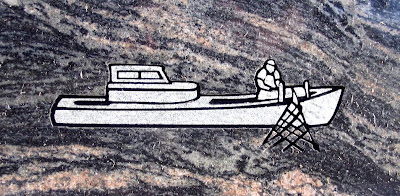
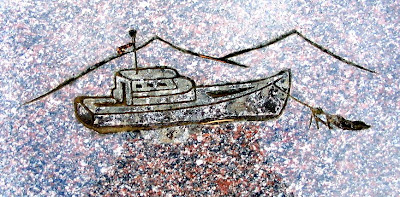
They are the classic fishing boats that these engravings illustrate. These are the kinds of boats I went out, ever so briefly, on. These are long-liners. Those tall poles sticking up from the side of the boats are just what they look like: oversized fishing poles that trail behind them hundreds of yards worth of fishing line set with hundred of hooks spaced evenly apart. The fisherman’s job is attaching bait to each and every hook and, God willing, removing fish from the same. And gutting the fish and throwing them down the hold and packing them in ice. In a storm. In a raging sea. With water walls sweeping the decks.

“Don’t fall overboard,” the skipper advises.

Roger that.

Eureka Cemetery (Newport, OR)

The poles also might have flopper-stoppers attached to them, which are steel plates secured to the poles by steel guy-wires. The plates race along side the boat a few feet below the surface, with their flat side parallel with it. The difficulty of pulling the plates out of the water broadside to are what make them effective in slowing down the rolling of the boat, hence the name. Should one of the flopper-stoppers actually escape from the water, God forbid, duck, because it’s going to come crashing through the cabin wall on the opposite side of the boat in a split-second.

Five of the six engravings shown here are of classic boats, all except the boat from Peaceful Hill (which looks more like a gill-netter) with the reflection in the water, which I threw in because of the unusual nature of the illustration.

Ocean View Cemetery (Warrenton, OR)

One engraving includes the Astoria Bridge, which crosses the Columbia from Oregon to Washington at that point. One can’t get much more place-specific than that on a tombstone.

The most dramatic of the engravings is that of the Northern Prince breaking the waves, poles lowered, the bow hidden behind the crest. It’s the only engraving that hints at what it feels like out there when “the minutes they turn into hours.”

The last Blogging a Dead Horse covered bowpicking gill-netters from the Columbia River. Long-liners ply the open ocean. One look at this collection and there’s no doubt: we’re not in Kansas, anymore.

Peaceful Hill Cemetery (Naselle, WA)

Thursday, April 9, 2009

Butterfly Sunset
Bowpickin' Gill-Netters on the Columbia

Greenwood Cemetery

It’s axiomatic to say that occupation is intimately tied to place. While telecommunications have theoretically liberated many fields from their locations, still, to be a fisherman, one needs water.

Boat images on tombstones, of course, are not limited to working boats, and pleasure boats are harder to geographically pinpoint than commercial craft. You may need water for sport boats, but you don’t need much. Commercial fishing requires big water. While some commercial fishing does obtain in fresh water, the vast bulk of it draws from salt water. In the Oregon Territory there is one great fishery not located in the ocean, that of the Columbia River; and while they catch a variety of fish in this mighty river, the bulk of the catch is salmon of one form or another; and the most efficient way to fish salmon in the river is via gill nets. Gill nets, as the name suggests, catch fish by entangling their gills in a net. Nets are designed of specific dimensions to catch only a certain size fish, while letting the rest escape, and at that they’re fairly effective.

Prairie Cemetery

(A word here on spelling: A boat that employs a gill net — or a gill-net, as the case may be — is known as a gill netter, a gill-netter, or a gillnetter. There seems to be no standard, even within a given publication.)

Gill-netting is an ancient technique probably predating our diaspora from Africa. It’s probably not coincidence that all hominin finds were originally laid down in moist conditions, with the only notable exception being a double set of footprints found in a then-fresh volcanic deposit. And it’s probably not coincidence that the diaspora appears to have been made via the shore of the Indian Ocean at such a speed and over such large aquatic distances that boats are a much better explanation than whole families swimming or being blown along on log jams. There’s probably a reason that invasions of new territory happened along river channels and not savannas or woodlands. There’s a reason why it’s now being considered that shell tools may have predated stone ones. There is a reason why people are known as the “beach monkey.” For that matter, we still all live at the beach, with our running water, and all.

Prairie Cemetery

In any event, The knot was undoubtedly one of the first serious human inventions/understandings that allowed us to explode as a species, as not only did it allow us to make clothes and fashion weapons so that we could finally extend our range off the confines of the beach, but it led, probably quite quickly, to making nets of all kinds; and it wouldn’t have taken too much fishing with nets to find out which size mesh worked best for which fish. Unfortunately, any materials used in making any but the most recent nets have long since vanished, so it’s currently impossible to date the origins of gill-netting, but suffice it to say it goes back a long, long way.

It’s most likely that gill nets were first employed along streams and estuaries without the assistance of boats, where they are still used by both commercial and indigenous fishermen. The advent of suitable craft allowed the fisherfolk to extend their trade into bigger and bigger waters, including the Columbia.

Ocean View Cemetery

The early post-invasion gill-netters on the Columbia were a colorful lot. Rowed to the fishing grounds and either powered or stabilized by sails, pictures of them show what looks like a flotilla of butterflies floating on the river surface. The current crop of motorized netters isn’t nearly as picturesque, but the more common style of Columbia River gill-netter, the bowpicker, is still a distinctive enough vessel and one that shows up on headstones much more often than the generally larger sternpicker.

The names describe how the net is pulled aboard the boat; and seeing as one has to be dragging a net towards them while reeling it in, it behooves the boat to be moving away from the net during the operation, which mean a bowpicker reels in the net while puttering backwards. Putting the net up front also lends the boat a distinctive appearance by moving the wheelhouse to the back rather than its more usual forward position.

Ocean View Cemetery

The Columbia gill-netters are generally small boats operated by one or two persons. At this point in time they are essentially an overlooked throwback, a once enormous industry now marginalized and whose greatest service to society is no longer the production of food but the retention of folkways. The headstone carvings shown here represent — can we say it? — a dying breed. They’re part of what makes life on the Columbia different from life on, say, the Mississippi (after all these years I can still remember how to spell that word). Similar boats, of course, are found over the entire world, but not uniformly distributed. Here they’re a beloved nuance of the Oregon Territory mostly restricted to the Columbia.

Prairie Cemetery

I may have missed a boat or two from my collection, and my collection holds photos of by no means all the boat carvings on headstones in the Territory, but the eight here are certainly a good selection of what’s available. They all emanate from cemeteries close to the river. And just by looking at them, I’d venture that six (I actually have one more that couldn't be downloaded) of the eight were fashioned by the same artist. Only the stained-glass representation in Cathlamet and the boat riding on a stylized sea of pointy waves from Ocean View look as if they’re done by other people. The remaining six look suspiciously alike. And, without being too harsh an art critic, the remaining six are intimidatingly simplistic in their execution. Notably so in an industry that generally does very fine work. It’s as if a folk artist snuck in for this tiny niche.

Stewart Creek Cemetery

What’s particularly nice, though, about this artist’s series of engravings is that, considered as a whole, they illustrate some of the high points of the job. Two of them show nets in the water; one of which shows the direction the boat is moving vis-à-vis the net, while the other shows a person working the net. Another shows a stabilizing sail unfurled, and another has two people sitting in the stern.

I might point out that the boat riding the stylized waves displays Washington State registration numbers, although the cemetery is in Oregon. It and the stained-glass memorial (the only depiction of the boats from a frontal view) reflect the generally higher industry standards of design; nonetheless, this artist’s contribution to the local headstone scene is significant and worth keeping ones eye out for. And I should note that this industry concentrates in the lower reaches of the Columbia, just before it enters the Pacific. The netters have never reached as far inland as Portland.

Ocean View Cemetery

Thursday, April 2, 2009

Down to the Sea in Crypts

Oysterville Cemetery

The mountains push down to the sea in Oregon. Beaches interspersed with rocky headlands muscle their way out of dense rain forests shagging their backs. Coves with no access are owned by sea lions whose roars can be heard miles inland. Time is measured by the long, slow moaning of a surf come from the center of an ocean that is anything but pacific. These mountains are low and hairy, twisted and broken. Logging road disappear into them forever, and too often the story is told of people who mistakenly drive into them in the winter never to drive out again.

Behind this range lies another range, the Cascades, taller still, whose peaks push above the tree line and hide glaciers in their crannies, but they are sparsely inhabited and given to logging and recreation. The loggers rake the Coast Range, too, but here the hidden valleys as often hide farms and ranches as well as gypo log outfits. There are tourists here, too, but other than fishermen in the rivers, most tourists turn their backs to the land and concentrate on the sea and the shore. There is one highway (101) tying the coastal hamlets together and most everything happens within a few miles of it on either side. The interior belongs to the locals.

As in most of America, the prevailing winds run west to east, and the clouds bulging over the Coast Range have to start dumping the loads they’ve gathered while drifting thousands of miles over the ocean. Rainfall in parts of the range can reach well into the triple digits, and rampant growth makes walking through the forest an impossibility. Cars, trucks, and whole houses can disappear within a few short years if left unattended, eaten up by vines. The closer one gets to the sea, the less distinct the boundary becomes between it and the land, and people who live too long by the brine slowly take on shades of sea life themselves.

Cemeteries are not exempt from the forces of Mother Nature. She doesn’t care if you’re dead; she’ll mow right over you, anyway. A cemetery on the Oregon Coast is as subject to being engulfed by blackberry vines and salal as any abandoned fisherman’s shack, and surely a large part of a sexton’s job here is holding the forest at bay. Which means that, if you’re looking here for cemeteries with a strong sense of place, you might have to look quickly before that place overwhelms that cemetery. That cemeteries do survive here for decades is testimony to perseverance.

Taft Cemetery

As noted here before, cemeteries, like golf courses and front lawns, tend to emulate certain characteristics of the English countryside, a legacy of the “rural” cemetery movement of the nineteenth century. A cemetery with a sense of place, on the other hand, blends in with its surroundings and makes of them a virtue. Which of necessity makes running a cemetery in a rain forest a bit of a compromise. One can’t simply let the forest go, or it will soon swamp everything. The trick is to maintain the sense of where you are without disappearing completely.

I’ve found three cemeteries which do that job particularly well (excepting that one of them is in Washington, but that state boasts the same clime as Oregon). They aren’t the only good cemeteries on the coast, and none of them is bigger than a nine-iron shot, and one is a bit tricky to find; but each is a little gem.

Technical Insert:

Precise location and driving directions (as well as more photos) to these cemeteries, as to all cemeteries in this blog, can be found at my Dead Man Talking Flickr site. Following the links will get you there.


Oysterville Cemetery

Of the three, Oysterville is the hardest to get to, simply because it’s further away from anywhere than the other two, but the rewards of driving up the length of the Long Beach Peninsula are many and amply repay the effort. If nothing else, it’s worth it to come up here to pay respects to the memory of the great wordsmith, Willard Espy, the town’s foremost erstwhile celebrity. If you don’t know who he was, more’s the pity to you. Espy’s memory is preserved in the Espy Foundation of Oysterville, “dedicated to advancing and encouraging the literary and visual arts.”

The Long Beach Peninsula is itself an anomaly of the coast. A good fifteen miles long, but no more than a couple wide, it’s essentially a big sand bar separating Willapa Bay from the Pacific; and the tallest hills on the spit are the hulking piles of oyster shells. What’s not given over to oyster shells or condominiums is consigned to cranberry bogs. Never has a place been so waiting for the master “oyster with cranberry sauce” recipe. (If it’s of any significance, I had the best scone of my life from a small wayside cafe halfway up the Long Beach Spit.)

There’s not really a there in Oysterville and the drive to the cemetery is just past the country store, announced by a sign with cutesy faux-old timey lettering. But let me reemphasize here the overwhelming desire of everything around here to grow rampant, so that any space not totally impenetrable has been made so by dint of human activity, and should that effort cease, the thicket would come rushing back in to fill the vacuum; hence open space here, and the space of the cemetery in particular, has the distinct feel of being surrounded by an enormous hedge through which the very light fails to fall. On the other hand, the liberated space has a sheltering feel, a place of peace on the teeth of the gale.

A gale had ripped the entire Washington and Oregon coast the winter before I made my sojourn to Oysterville, and whole swaths of forest had been leveled. In places it looked like the aftermath at Verdun. The damage was not uniform. Some place suffered only moderate destruction while other places were entirely obliterated. Fortunately, the cemetery was spared the worst of the ravages. What damage it did suffer was confined mainly to the edges.

What can’t be missed upon driving past the entrance columns is the large, wooden headboard over a grave outlined with gray rock and scattered with shells for Chief Nahcati (1826-1864). The board has to be 2’ x 5’ or better, and God only knows how long its been here. Surely not since 1864. The significance of the Chief to the place is unexplained, but someone is keeping his memory prominent.

Oysterville Cemetery

Past the Chief’s grave the cemetery winds between bushes and trees, so that only parts of it are visible at any one time, and turning new corners opens new delights, not the least of which is the stone for William Bonner Bailey (1937-1992). Looking somewhat like a massive gray potato rising out of a gentle rise covered with low native perennials, it’s carved with his name and the words:

the fish are rising
the children are laughing with joy
Bon’s free and at peace


In its way it is the perfect marker in a perfect cemetery that lives in the lungs of the sea. A land ruled by moss and wind.

It’s a long drive up the spit and the tsunami evacuation route signs offer no confidence. Still there’s no place like it in the Oregon Territory and the cemetery is not to be missed.

And it would make Willard so happy.

Taft Cemetery

Taft is the antithesis of Oysterville. If Oysterville is hidden and secluded, hunkering down against the constant might of the Pacific, Taft is resolutely bold, thrusting its chest at the brunt of the ocean, from a cliff high above the surf. Storm be damned! If Oysterville is cloistered, Taft is exposed. No room for sissies or dilettantes here; only those with the vision to see forever. I don’t know what the rest of the world is like, but there’s nothing like the Taft Cemetery anywhere between Coos Bay, OR, and Raymond, WA. There are other cemeteries with ocean vistas — Fern Ridge above Seal Rock, OR, comes to mind — but but none with the commanding view of Taft. Despite being right above a resort, one would never know it, the awesome nature of the view is too distracting.

Taft Cemetery

Taft expresses sense of place, not by becoming one with it, but by lording over it. This is the ocean lover’s cemetery and, even given its small size, has inspired a number of interesting markers, many of them homemade, the most impressive being that for Colleen Fletcher (1965-1992). Colleen was a sergeant in the US Air Force in Vietnam and her face adorns a large concrete pedestal topped with a statue of the Virgin Mary as if she’s maintaining a vigil over our shores, protecting us once again. We’ll never have to worry about a sneak attack from Hawaii because Colleen is on the job.

Carson Cemetery, the last of the coastal properties we’re looking at, is a whole other kettle of fish. It’s hard to believe anyone could actually be buried there. And it’s the hardest to find. Driving directions are to take Yachats River Rd. east out of Yachats. After 4.8 miles (according to my odometer) Carson Rd. enters from the north (left). Take that. The cemetery is up the first drive to the right (east) off Carson Rd. I don’t recall if there’s a sign at the road or not, but I think not. For pin-point accuracy, I recommend you visit my Flickr site, select a single photo to look at, and then following the map link.

But I’m going to cheat here. I wrote fairly extensive notes for the cemetery in 2005 and I can’t imagine too much has changed since then. And anyway, the Morgans deserve a little publicity. So, with no further ado:

Carson Cemetery

CARSON CEMETERY

Hwy. 101 is an ocean-side carney ride almost without let up from California to the Washington border. Any time of the year the traffic can be maddening, but in summer it’s insane. Tacky gift shops, smoked salmon shacks, and seaside resorts mixed with auto glass places, outlet shopping malls, and used boat centers line the highway for miles on end, broken here and there by jutting headlands. Four thousand cafes serving bad clam chowder. It’s awesome.

Whereas a turn inland down almost any road will find one in an oft sparsely settled valley dripping with moss and drained by fast running streams. A few cows in the stream bottoms constitute a farm. People here drive pickups and wear mud boots. They live unseen by the conveyor belt of people lurching past the mouth of their valley. People not even aware the valley is there. Not aware that people live in the hills behind the mist.

The Yachats River Rd. reaches into one such valley. Some valleys, like those of the Alsea or the Umpqua, have roads that continue further, opening up to the interior; but the blacktop up the Yachats disappears into the maze of forest roads which web the Coast Range. There’s not much call for anyone besides residents and log-truck drivers to wend their way along this minor river. Yachats, named for a now-extinct Indian tribe and perfectly charming in its intimate location, will always draw its share of visitors; but the river road behind it will continue to be a local pathway only, save for two lesser, if quintessential attractions. One is a covered bridge crossing the Yachats about six or seven miles from town. Turn left at the T and the bridge is another mile or two upriver. By this point, the road is down to a one-lane dirt road, so drive carefully.

The other attraction, reached before the covered bridge, is the Carson Cemetery. As mentioned, it’s off Carson Creek Rd.; but Carson Creek Rd. is used by hardly anyone—even less than the Yachats River Rd.—so the chance of one accidentally running across the cemetery are practically nil. There is a sign for Carson Creek Rd., which runs north off Yachats River Rd., but I missed it on the ride up and didn’t see it till coming back down the road, after stopping for directions at a bed-and-breakfast run by Sam and Baerbel Morgan. Once you’re on Carson Creek Rd., the cemetery is the first drive to the right.

Asking at the bed-and-breakfast was the key. I was given directions by a pleasant and obviously knowledgeable lady with a slight accent, who I took to be Baerbel Morgan. At the entrance to the cemetery a sign explains that contributions to its upkeep can be sent in the cemetery’s name to the Yachats Lions Club (Box 66, Yachats, OR 97498—feel free), and that the caretaker is one Sam Morgan. Ah ha! the plot thickens.

It thickens further when one notices that a new and unusual stone marks the grave of one Sam Morgan (1938-1999). I would imagine it’s Baerbel, now, who does the maintenance. At least someone is keeping the brush at bay and providing the plastic flowers in this what looks for all the world like a Hobbits’ graveyard. It climbs a steep hillside through an uncleared forest and it doesn’t look like there’s room enough for whole bodies at most grave sites. At least not whole human bodies. While the underbrush has been replaced by rhodys and boxwoods, the forest floor is still a a tangle of roots that surely gives any gravedigger fits. The majority of the graves have either handmade markers, funeral home tags, or none at all. The cement, hand-lettered stone for James Ingram is typical. He was “born 1821 Tenn.” and “died 188[?]/ near here.” S. Traves has his name—no dates, no nothing else—held up by a curved length of rebar. Zanta Clarno’s (1888-1950) “A Saintly Lady” on metal plating set in black stone is an exception.

One feels that, were it not for the Morgans, this cemetery could well have been lost by now. Instead they’ve maintained a cemetery unique in our experience: one being built into the existing forest rather than having it cleared first. There’s a picnic bench and a couple of plastic chairs off to one side, and one has no doubt that social occasions obtain here from time to time. A white, quasi-bird house containing a glass-covered copy of Longfellow’s “God’s Acre” centers on a sunny spot in this magical cemetery:

Carson Cemetery

GOD'S ACRE


I like that ancient Saxon phrase, which calls
The burial-ground God's-Acre! It is just;
It consecrates each grave within its walls,
And breathes a benison o'er the sleeping dust.

God's-Acre! Yes, that blessed name imparts
Comfort to those, who in the grave have sown
The seed that they had garnered in their hearts,
Their bread of life, alas! no more their own.

Into its furrows shall we all be cast,
In the sure faith, that we shall rise again
At the great harvest, when the archangel's blast
Shall winnow, like a fan, the chaff and grain.

Then shall the good stand in immortal bloom,
In the fair gardens of that second birth;
And each bright blossom mingle its perfume
With that of flowers, which never bloomed on earth.

With thy rude ploughshare, Death, turn up the sod,
And spread the furrow for the seed we sow;
This is the field and Acre of our God,
This is the place where human harvests grow!


Pull up one of the lawn chairs and sit here in the evening. Make no sound and slow your breathing to a sigh. Wrap a blanket around your shoulders and wait for the little ones to come out. I’m sure they will. It’s that kind of place.

Carson Cemetery

Thursday, February 26, 2009

South Coast Literati

Reedsport Masonic Cemetery

Last week I made a quick trip to a stretch of the southern Oregon Coast, visiting old haunts, old friends, and a handful of cemeteries. It will take me a little time to get all the photos uploaded onto Flickr, so I can’t as yet link you to the cemeteries; but I reaped a handful of interesting epitaphs that I figure wouldn’t hurt to display now. In fact, proportionally, I did better with epitaphs than with monuments. Who knew they would be so literate down there?

It must be said that Coos County and the Coquille River Valley form a world apart, only tenuously attached to the rest of Oregon. Or the rest of America, for that matter. We’ve long observed that, not only do they march to a different drummer down there, it’s not clear that they even have a drum. What is true is that there’s more farmable land in the valleys of Coos County than anywhere else in the Coast Range, though much of it is hidden to the casual visitor. The hills are not as tall here as they are to the north and south, yet they scramble the countryside thoroughly and snake valleys far away from what passes for civilization in these parts. Despite being an area of early white settlement, there is still a rawness and roughness prevalent here that has long since been wiped from the rest of the Coast. Only recently did the logging mills disappear from the Coos Bay waterfront, and only now are tourists making serious inroads into pockets near the sea. Still, it will be a long time after the headlands are rimmed with second homes before the vacationers will make significant forays into the interior. It’s a long ways back in there and it’s not clear to where it goes. Road signs in the mountains can be scarce or lacking altogether, and winter is not the time to get lost in there. Wisdom says, stick to maintained roads and don’t drive at night in the rain. Highways can slide down hillsides with no notice.

Sunset Memorial Park

But enough geography. On to the epitaphs:

The first two cemeteries I visited are actually in the Umpqua River drainage, to the north of Coos County. The Umpqua harbors its own particular culture which interacts considerably with the Coos/Coquille folk, but which is strikingly different, as its major agricultural and population center is far inland and has distinctly different growing conditions from the fog-shrouded, drizzled coast.

Scottsburg gives us two epitaphs:

The Daileys, Paul (1928-1991) and Marcella (1932-1999), repeat one I’ve recorded elsewhere: “Where there walks a logger there walks a man.” A search of the Internet turns up references to a CD of the same name as that phrase from the 70’s by one Buzz Martin of “Five Rivers area,” Oregon; early and local enough to have been the inspiration for both my citations. On the other hand, there could be a prior source for all of them.

Claude (1922- ) & Frances (1923-1998) Friend have a gorgeous bronze plaque that also carries a reference to logging, of sorts, but theirs is a little less strident, a little more welcoming. Indeed, with its folksy twang and soft edges, it’s got “Jimmy Stewart” written all over it: “Tried to leave the woodpile a little higher than we found it.” They claim “four beautiful daughters,” who are surely warmed by that woodpile to this day.

Scottsburg Cemetery

The next town downstream from Scottsburg is Reedsport, which, while founded in 1852, wasn’t platted until nearly fifty years later. Reedsport is more or less the town at the mouth of the Umpqua, though that honor is technically held by the smaller Winchester Bay (which predates Reedsport by two years).

The Masons provided the main cemetery in Reedsport. I recorded a couple interesting epitaphs from there. Jamie Palmer (1983-1999) represents the occasional constant in epitaphs: the enigma. Hers is “They’ll always be five.”

Five what? She was sixteen when she died. “They” implies people. Are we talking age or number?

Advice (other than the “ones good deeds live after them” sort) is scarce on tombstones, but some people carry their idealism to the grave. The twenty-year old Steven Mix (1953-1973) left us with an uplifting homily, reflecting, perhaps, his youthful ardor:

Before you abuse mock and accuse be sure
You have walked a mile in your neighbors shoes


When we finally get to Coos Bay, we find the cemeteries dominated by lawn cemeteries, and despite the concentration of population, the metro area offered the slimmest pickings. In fact, the only interesting memorial I recorded was a modest one to the quasi-mythic distance runner, Steve Prefontaine (1951-1975), for whom this was his home town. Steve died in a car accident but he is still honored here in his home state. His is the only upright tombstone allowed in Sunset Memorial Park. The epitaph is unassuming:

Our beloved son and brother
who raced through life
now rests in peace


Sunset Memorial Park

It was the delightful and obscure Coos River Cemetery, though, that provided the best lode of epitaphs. It’s listed on ePodunk as the South Fork Cemetery, but don’t believe it. The handmade sign says otherwise.

When it comes to obscure and inscrutable, William Gilmore (1839-1937) is in a class by himself. Shortman and I stared at his stone for a long time, but came to no conclusions. Whatever Mr. Gilmore was trying to say, it went to the grave with him. You tell me what you think it means:

Theinheriet laws
matter is the crea-
tor of the universe


Go ahead, read it as often as you like.

Coos River Cemetery

Al Lewis’s (1899-1975) stone is notable for its simple elegance as much as its John Wayne inspired epitaph: “He had true grit”; whereas Alice Spear’s (1923-1989) epitaph is notable for its playful nature. The marker was adorned with musical notes, so I presume the epitaph was lighthearted:

They said she was too different
and she wrote too many tunes.


Yet as a heart-tugger it’s hard to top the four words left on Manuel Rodriguez’s (1946-2003) headstone:

I miss my friend.

And so it goes.

Coos River Cemetery

Saturday, January 31, 2009

Department of Correction and Amplification


Lest I lead you astray, forget everything I’ve said about Willamette National Cemetery. It’s still there, but the ephemera behind the berm have been removed. It’s as sterile as a DI’s… well, you get the picture.

It’s evident that the folks at the VA don’t read this blog (ho-ho) or they might have thought twice about removing the ephemera. Then again, being military bureaucrats, probably not. The US is known the world over for its military cemeteries, for their dignity and often dramatic landscaping; but warm, homey places they’re not. In the end, the Army’s going to bury you in a barrack, too.


Which isn’t to say I don’t like VA cemeteries, I do; but there’s something forlorn about a person standing in the middle of a barren field, head bowed, quietly staring at a patch of concrete at their feet. Makes you long for an inflatable teddy bear, after all. Maybe a plastic whirligig.

In any event, if you’re looking for the equivalent of the Vietnam Wall up behind the berm, like I promised, you’re going to be disappointed. It’s too bad. I’d written to the local press about the ephemera, but no one ever went up and looked. There was no Maya Linn, no big bucks. Just relatives of the deceased. People. You, me. People. Nothing special to write about.

Too late now.

Ciao

Thursday, January 29, 2009

Greatness Large & Small

Eugene Masonic Cemetery

Some are born to greatness, others acquire it after long struggle, and others have it thrust upon them. People? No, cemeteries, of course.

I recently ran across a one-post blog (there are a lot of them out there) that said some tantalizing things about cemeteries and made a number of suggestions as to how to pump more life into them, which may seem a touch counterintuitive. My favorite suggestion was to stick a high class restaurant into the middle of them, although I’m not sure how that would work. You go talk to your local cemetery about it.

The author also suggested some things already being done in some cemeteries such as readings; small, historical drama presentations/reenactments; concerts; etc. All in all, practicality of some ideas aside, it was good to see someone thinking about how to restore cemeteries to their former glory. As anyone with a passing knowledge of cemetery history knows, cemeteries were the precursors to parks; and while parks have evolved to fulfill functions cemeteries couldn’t approach, it doesn’t mean that they have outlived their usefulness as parks.

Lone Fir Cemetery

There are two cemeteries in the Dead Man Talking database that are heading back towards being parks. Indeed, they already are parks as much as they are cemeteries: Portland’s Lone Fir and the Eugene Masonic Cemetery. The Eugene cemetery is an exemplar of the rural cemetery movement and had a streetcar line delivering people to its doorstep, even though it was, like other “rural” cemeteries, out in what was then the countryside. That was being born to greatness. Unlike Portland’s River View, a rural cemetery which also was built for but has continually maintained its greatness, Eugene Masonic had a long period of decline and suffered serious vandal damage (and still does) before being consciously returned to greatness by taking a radical new approach as to how the cemetery is regarded and used. It’s all Eugene and all Oregon and it gets constant use by its neighbors. Lone Fir also gets constant use, though it approaches being a park in a more traditional manner.

River View Cemetery

Eugene Masonic is notable at first glance for its shaggy appearance and at closer inspection for the minute detail with which the cemetery is cared for and presented. It looks shaggy because the site is mowed but twice a year and functions as a local wildlife habitat for both animal and plant species. Walking paths throughout the cemetery are kept mowed and are sprinkled with signs ecumenically pointing out significant local species or interesting interments; and to their credit, the interments signaled out for illumination are not necessarily those of city luminaries, but also include short bios of more representative citizenry. (Historical markers always tell as much about the erectors of the markers as the people or events they are commemorating.) They’ve also begun to allow green burials, have erected a charming viewing platform and scatter garden, restored an art deco mausoleum on the property, and a local Jewish organization has reserved part of the cemetery for their members’ use (a practice also found in two Portland pioneer cemeteries). Things are hopping there and neighbors love to come there with their children and dogs, which are kept on the paths and scrupulously cleaned up after (both kids and dogs).

Lone Fir, on the other hand, began life as a Donation Land Claim (DLC) cemetery; which simply means that the original owner of the land set aside part of his or her holdings to serve as a cemetery, one of the most common origins of Oregon Territory cemeteries. Lone Fir grew to greatness due to its location. It too was built in the countryside and soon swallowed by the city outside which it lay. It grew to greatness by having a rich and complex history, which is still evolving. Not designed as a “rural cemetery,” it nonetheless is a major city arboretum and that lone fir (which still stands) has been joined by an astounding variety of trees. It also contains some nice little niche areas, such as a firemen’s section, a heritage rose garden, a Gothic mausoleum, and an emerging Chinese memorial commemorating the Chinese who were disinterred from this cemetery and shipped back to China, providing, of course, that they were adult males. Chinese women and children were left behind. Lone Fir is also the repository for the lion’s share of the interesting monuments in the city; and this goes back to the early days, as it harbors by far the city’s largest collection of Woodmen of the World faux stumps. Yet the modern revival of individualized memorials is well represented here too, with striking new monuments. Not to mentions the proliferation of Russian tombstones with their fanciful scenes and babushkaed photos laser-etched onto black granite. They are ubiquitous. Along with their gardens. The Russians love to create miniature gardens on their cemetery plots, and all summer long you’ll see well dressed women hiking back and forth between water spigots and small garden plots. As a consequence, the once somber tones of the cemetery have been enlivened by countless color spots. It’s all good.

And as a consequence Lone Fir gets heavy use. Not only are the plots going fast (we bought two), but the place is always attended by people. All manner of folk drift though reading the stones or stopping by for a picnic lunch, weather permitting. Musicians can sometimes be found playing quietly in the marble forest, and many a reader has found a comfortable stone to rest their back upon. Drinking isn’t a problem; the grounds are much more likely to be used for smoking a joint. It’s still peaceful, after all.

But greatness in a cemetery is not necessarily defined by its use as a park. Most of the cemeteries in the database that I’d mark as “great” (and surely greatness, like beauty, is in the eye of the beholder), get little or no park use. Which may be too bad, but it’s true.

Mountain View Corbett Cemetery

“Great” has more to do with ambiance than size. Location helps. Mountain View Corbett Cemetery, the eastern most of Metro’s fourteen pioneer cemeteries, has such a close-up view of Mt. Hood and the surrounding agricultural fairyland that, if the wind’s not blowing, makes it a delightful place to be. For a tiny cemetery, it has more than its fair share of personalized monuments, another mark of a great cemetery. Taft Pioneer Cemetery with its majestic view of the Pacific Coast has also inspired above average memorializations. Pleasant Hill Cemetery, on the other hand, while having one of the best caches of personalizations in the state, is located smack alongside busy Hwy. 58 southeast of Eugene. I attribute its lively character to being close to Ken Kesey’s ancestral home. There’s still many a Merry Prankster hiding in the woods of Lane County. In any event, it proves one can have a splendid cemetery in a mediocre setting.

Pleasant Hill Cemetery

Genealogists and local historians might qualify “great” by who, how many, and what kind of records a cemetery possesses. Willamette National would qualify by many standards as a great cemetery, but other than nice lawns and beautiful committal chambers its really only “great” aspect is the personalized memorials hidden behind berms at committal shelter no. 3. Those moved me to tears. But I can see a genealogist going ga-ga over the records. Though I can’t understand how the Vietnam Wall can get such publicity, while the memorials behind the berm are ignored. Go to Dead Man Talking Flickr site and see for yourself. It only scratches the surface.

Willamette National

I qualify cemeteries by how I feel when I stroll around them. That’s how I began. Inveterate backroaders, cemeteries have long been a pleasurable stopping point for Kay and me while traversing the outback. A good place to check out a few stories, get a grip on community history, and see how the locals handle death. Always a fun trip. Approached that way, a cemetery has to stand on its own merits. The stories behind the tombstones will remain enigmas. The making up of ones own imaginary history is often good enough. In any event, who is buried in a cemetery is of little import for the casual visitor, and what constitutes “good” in a cemetery has to be apparent at first glance. Cemeteries are defined by the memorials they keep.

Taft Pioneer Cemetery

That’s my take, anyway. Thank God you have yours.

See you at the sepulcher.